

The Ground Beneath the Game, Part Two: From Neighborhood Ballparks to Billion-Dollar Sports Districts
How stadiums, housing, public money, and private development became intertwined — and what that means for the people living nearby.
Created with ChatGPT research and writing assistance. · Both parts available in this weekend edition.
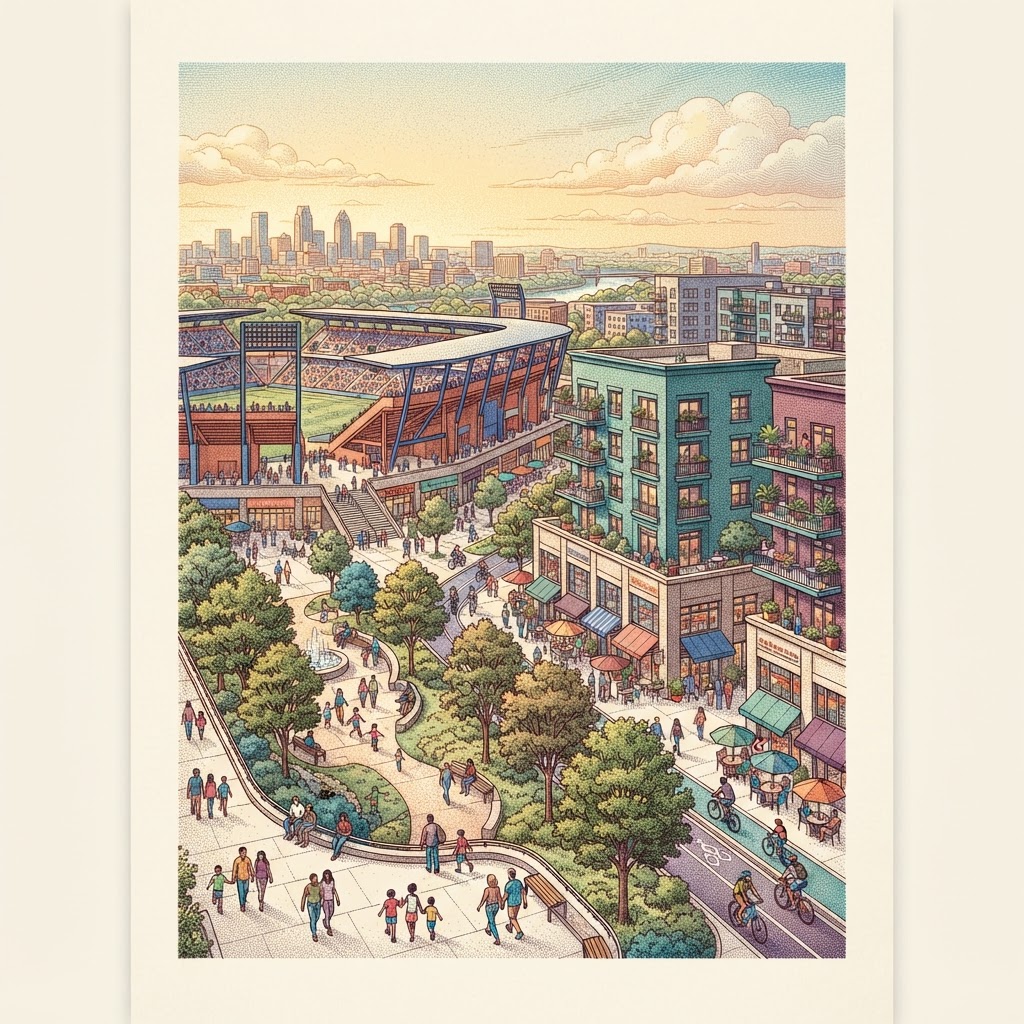
Part One ended with the neighborhood ballpark — a stadium that belonged to its streets. Part Two follows the twentieth and twenty-first centuries, when the land around the game became a business in its own right: financed with public money, entangled with housing policy, and increasingly planned as whole districts. The same central question runs underneath: when people gather to play and watch, who controls the ground — and who benefits?
The twentieth-century stadium city
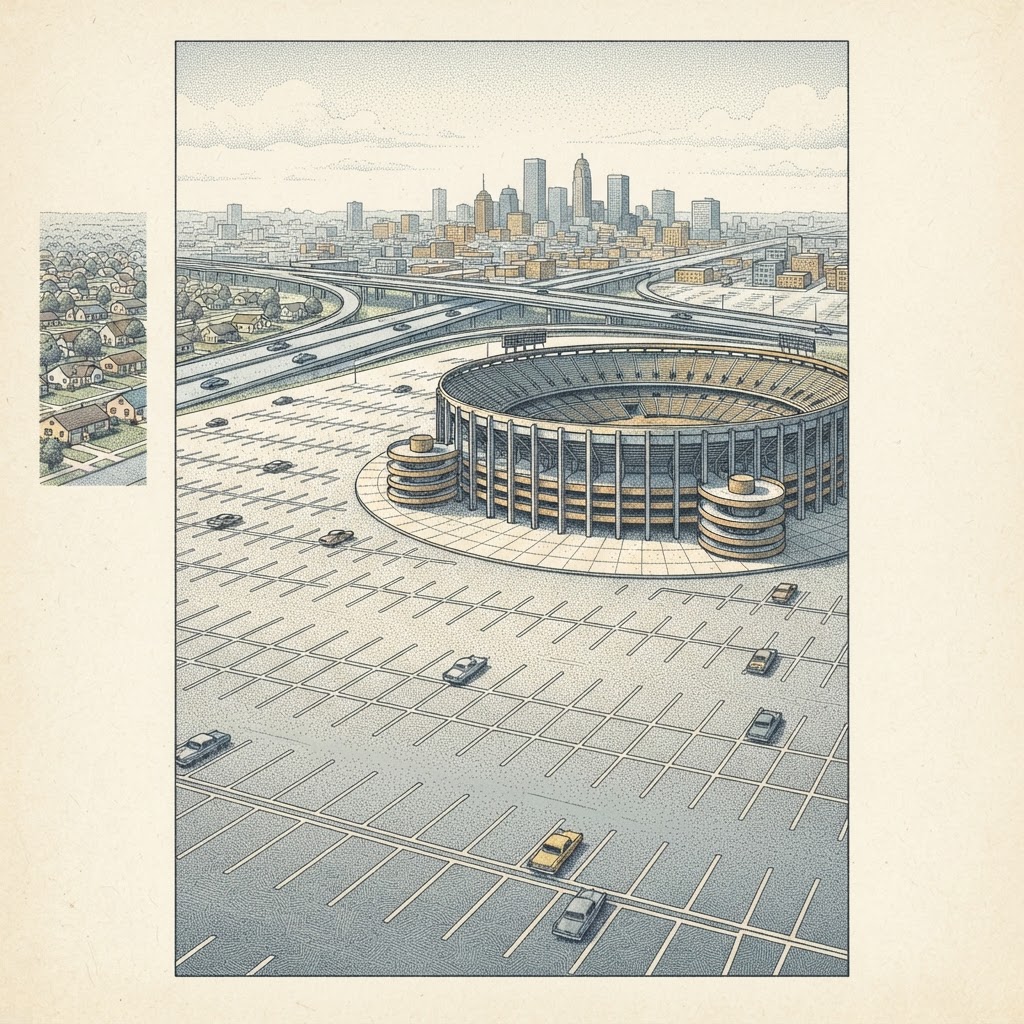
As professional leagues consolidated and cars and suburbs reshaped American cities, the dominant stadium type changed. Grand urban ballparks gave way to large multi-purpose bowls, often placed near highways with land to spare — and the land was the point: these venues needed thousands of parking spaces, not walkable residential streets. The automobile-era stadium sat in a concrete sea at the urban edge, close enough to the city to claim it, far enough to be reached by car. That placement was a choice about land values, assembly, and who was expected to arrive — and it traded neighborhood intimacy for parking capacity. [1]
Homes, access, and exclusion
The same decades that produced stadium cities were built on housing systems that decided who could live where — and those decisions are part of this story, not background. From 1934 into the 1960s, the Federal Housing Administration institutionalized redlining, rating neighborhoods for mortgage risk in ways that treated Black presence as decline and favored new suburban construction; the FHA's 1938 Underwriting Manual even endorsed racially restrictive covenants. [2] The 1968 Fair Housing Act outlawed racially motivated redlining, but the map it corrected had already steered decades of investment. [2]
Public recreation has its own displacement history. Fort Reno Park in Washington, D.C. — today a set of ball fields and a concert series — sits on ground that was once Reno City, a working-class community where Black families bought and rented land after the Civil War. From the 1930s into the 1950s, federal and District officials, backed by local citizens' associations, acquired and cleared the neighborhood to create parkland and schools; residents protested at Congressional hearings and lost, selling under threat of condemnation at prices that made replacing their homes nearly impossible. [3] The lesson is direct: when a neighborhood is described as the site of future parks or venues, someone lived there. Neighborhood clearance is not an empty-land development story.
The stadium as a financial project

Building a modern stadium is a stack of financial instruments. Land must be acquired — sometimes assembled parcel by parcel, sometimes through a city using eminent domain or a land purchase. Construction is financed with bonds, increasingly tax-exempt municipal bonds whose interest costs are lowered by federal law. Revenue comes from leases, naming and sponsorship deals, premium seating, and event income; infrastructure — roads, transit stops, utilities — is often a separate public project that makes the site workable. Economists Roger Noll and Andrew Zimbalist, writing for Brookings in 1997, documented the federal dimension: tax exemption on stadium bonds has historically cut borrowing costs by 2.4 to 4.5 percentage points, a subsidy that for one $225 million stadium was worth roughly $70 million in forgone federal revenue. [4]
“A stadium budget and a district budget are different documents, and confusing them is how big numbers get approved.”
One distinction is essential for reading any headline about stadium money: the stadium's budget and the surrounding development district's budget are different documents. A stadium's price tag covers the bowl and its operations; a district's plan may include homes, hotels, offices, parks, and parking structures financed by many parties over many years. When promoters cite hundreds of millions in “investment,” it matters which document they are reading from — and who is committed to which line.
Beyond game day: the mixed-use sports district
The current model answers a simple economic problem: a stadium sits idle most of the year, so developers plan the land around it to work every day. The mixed-use sports district wraps a venue in apartments, hotels, restaurants, offices, retail, and public space. Three projects show the pattern — all verified as of the October 16, 2026 research cutoff, and all still in progress rather than finished neighborhoods.
In San Diego, the city has released proposed real estate agreements for the 48.5-acre Sports Arena site: plans for 4,250 homes, including at least 2,000 affordable units, a 16,000-seat entertainment center, 14.5 acres of parks, and roughly $460 million in developer-fronted public amenities — with the central disposition agreement still subject to committee and council approval. [5] In Denver, the city's draft plan for the 58-acre Burnham Yard rail yards around the Broncos' preferred stadium site carries more than 30 recommendations, from affordable on-site housing to transit and trail access; the planning board's decision was expected in early 2027. [6]
And women's professional sport now has a district story of its own. Denver's NWSL club, Denver Summit FC, is building a 14,500-seat stadium at Santa Fe Yards that its city council approved a $50 million land purchase for in December 2025; the club finalized the land acquisition in March 2026 and broke ground on October 1, 2026, targeting the 2028 season for a stadium designed specifically for women's professional soccer at the anchor of a 14-acre mixed-use district. [7][8] A stadium under construction is a promise, not a neighborhood — but it shows the model expanding beyond the men's leagues that built the first wave.
The athlete and the property market
There is a quieter residential chapter too. Athlete homes — listed estates, traded players selling condos, championship earners buying in tax-favorable cities — became a running beat in the property press, and the amounts involved are real. This publication's own weekend edition tracks such listings alongside stadium news, because both are the same phenomenon viewed from different altitudes: sport as a generator of property transactions. What deserves restraint is motive. Reporting can say that a player listed a home after a trade; it should not guess at anyone's finances or reasons.
What the evidence says
So is it worth it? The honest answer from the economic literature is more skeptical than most ribbon-cutting speeches. Noll and Zimbalist's review of facility case studies concluded that a new sports facility has an extremely small — perhaps even negative — effect on overall economic activity, that no recent facility had been self-financing in net tax revenue, and that promotional studies overstate benefits by confusing gross spending with net growth: most money spent inside a stadium substitutes for other local entertainment spending rather than adding to it. [4] Their much-cited example: even Oriole Park at Camden Yards, arguably the most successful new ballpark of its era, produced a net gain to Baltimore's economy of only about $3 million a year against a $200 million investment. [4]
None of that erases what stadiums visibly deliver — civic identity, gathering, and real if modest business for nearby restaurants and bars on event days. The distinction that matters is between spending near a stadium and growth across a city. Spending near a stadium is often real and local; net economic growth across a metro area is the much higher bar the evidence says facilities rarely clear. And nothing in the literature supports the claim that a stadium automatically raises nearby home values or pays for itself. [4]
The view from the renter's side
I write SOLDWIRE from the renter's side of the door, and I have not personally watched a district rise around a stadium — so rather than inventing experiences, here are the questions I would ask of any sports district announced near where people actually live. Can existing residents afford to remain? Are new homes included, and at what share affordable? Is the public space useful outside events, or is it a corridor that empties at the final whistle? Can people reach it without paying for parking? Who receives the financial benefit — the team, the developer, the city's tax base? And who bears the cost if the projections fail? Those questions have answers, and districts differ in how they answer them. The difference between a district that serves a community and one that merely parks next to it is usually decided before the first shovel.
Modern times and the next chapter
Several currents suggest where the story goes next — offered as possibilities, not forecasts. Women's professional sport is winning purpose-built venues, as Denver's project shows, which may set new defaults for where stadiums sit and whom their districts house. [7] Adaptive reuse keeps proving that old grounds can learn new roles; the Colosseum itself spent centuries as quarry, housing, and shelter before becoming one of the world's most visited monuments — a reminder that venues change uses over long arcs of time. [9] Climate resilience, accessibility, and year-round community recreation are increasingly part of the brief for new facilities, and the districts that treat those as requirements rather than garnish will be the interesting ones to watch.
“The best districts will be planned around people who live there all year — not just the ninety minutes when everyone is watching.”
The through-line of this series is that sport and land have always written each other's rules. We built places to gather before we built places to profit from gathering; the stadium city and the sports district are recent chapters, not the natural end of the story. The open question is whom the next chapter serves — and that will be decided, as it always has been, by decisions about ground: who owns it, who pays for it, and who gets to stay.
A compact timeline
- 1914–1920sNeighborhood ballparks anchor residential districts — Wrigley Field's model of a stadium as a good neighbor. [9, part one]
- 1934The FHA begins operations; federally sponsored redlining shapes which neighborhoods receive mortgage investment. [2]
- 1930s–1950sReno City, a Black working-class community in Washington, D.C., is acquired and cleared for parkland and schools. [3]
- 1968The Fair Housing Act outlaws racially motivated redlining. [2]
- 1997Noll and Zimbalist's Brookings review finds new stadiums' net economic effects “de minimis” and none self-financing. [4]
- Dec 2025Denver City Council approves a $50 million land purchase for Denver Summit FC's purpose-built NWSL stadium at Santa Fe Yards. [7]
- Oct 2026San Diego releases Midway Rising agreements for 4,250 homes on the 48.5-acre Sports Arena site; Denver Summit FC breaks ground October 1. [5][8]
Sources & Further Reading
- Federal Reserve History — Redlining (essay)
- National Park Service — Fort Reno Park: A Brief History of Reno City
- Brookings — Noll & Zimbalist, “Sports, Jobs, & Taxes: Are New Stadiums Worth the Cost?” (1997)
- Inside San Diego — Details Released for the Redevelopment of the Sports Arena Site (Midway Rising)
- Axios Denver — Housing and transit anchor vision for Broncos stadium site (Burnham Yard)
- The Denver Post — Denver Summit FC acquires land at Santa Fe Yards for future stadium (March 2026)
- Denverite — Construction officially underway on Denver Summit FC's permanent home (October 2026)
- SOLDWIRE.US Weekend Edition — verified source-linked stories on Midway Rising and stadium districts (Oct 17–18, 2026)
- Parco archeologico del Colosseo — The Colosseum (official site)
- Further reading: Brookings — Economic development in its place