

The Ground Beneath the Game, Part One: From Ancient Gathering Places to the Birth of the Stadium City
Long before luxury suites and stadium districts, communities needed somewhere to gather, compete, and belong.
Created with ChatGPT research and writing assistance. · Both parts available in this weekend edition.
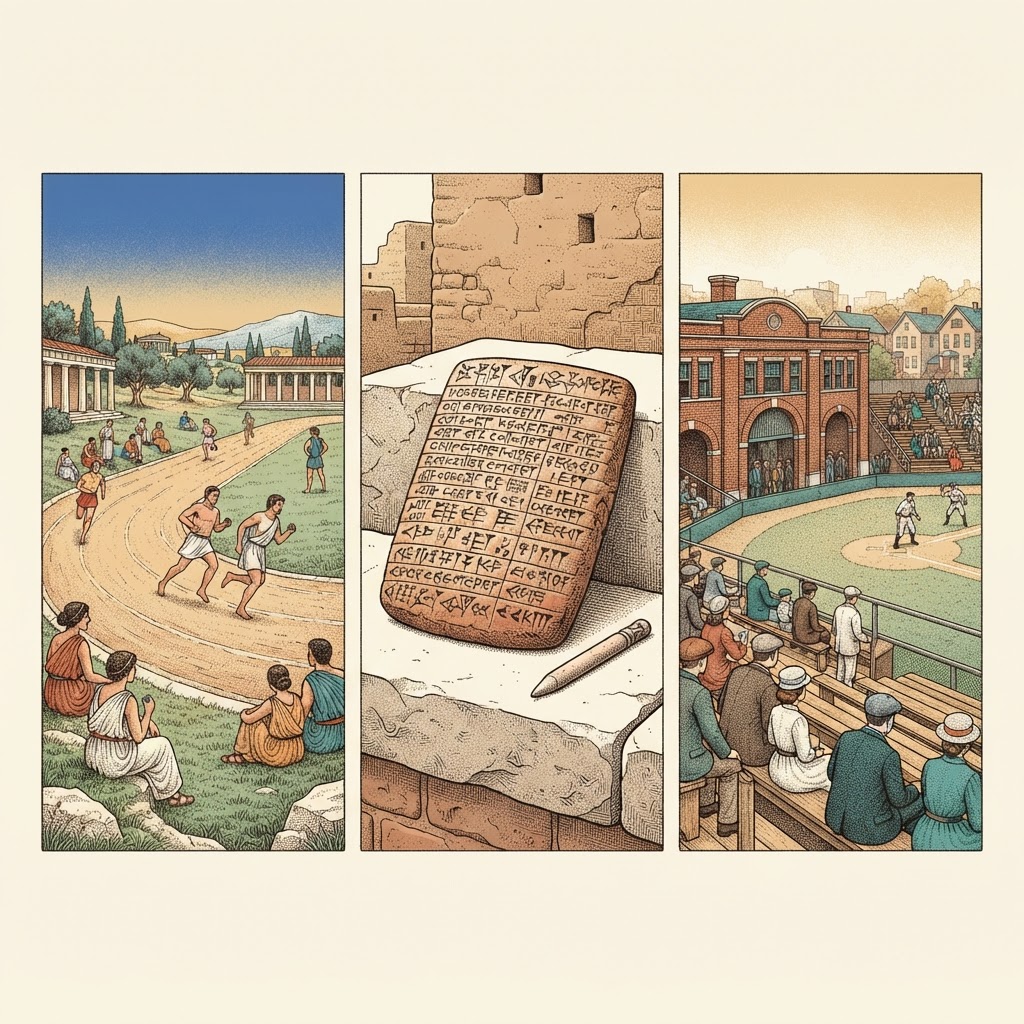
When people gather to play and watch, who controls the ground — and who benefits from what gets built around it? This two-part series looks at how sport and the use, ownership, development, and financing of land have shaped one another. Part One follows the long road from shared gathering places to the first neighborhood ballparks. Part Two, published Sunday, follows the money into today's billion-dollar sports districts.
Here is a humbling place to start: nobody knows when sport was invented, and nobody knows when property was. Both were assembling themselves for thousands of years before anyone wrote them down. There is no single invention date for either — and the concepts themselves are not identical across cultures. Possession, land tenure, communal rights, and modern private real estate are different ideas that different societies built in different ways and in different orders. What we can do is follow the surviving evidence: earthworks, tablets, ballcourts, enclosure maps, and ballparks that still stand.
Before the stadium: shared ground and practical play
For most of human history, physical competition did not need a dedicated building. People ran, wrestled, threw, and danced at crossroads, on riverbanks, in temple precincts, and on open ground that also served grazing, markets, rituals, and assemblies. Gathering places for play were rarely separate from gathering places for everything else a community did — and that overlap is the first clue in our story. Sport and land were never strangers; the question was always who could use the ground, when, and on whose terms.
Archaeology can show where people gathered and what they built; it is far less certain about the rules they played by or how ordinary the games were. That line between evidence and speculation matters, because the temptation is to read modern assumptions backward. A grassy bank used for watching a race is evidence of gathering. A line in an ancient poem is evidence that someone imagined a game. Neither is a blueprints-and-permits story. What the record does show, widely and repeatedly, is that communities treated play as something worth organizing space around — long before anyone charged admission.
When land became a written transaction
Meanwhile, a parallel story was unfolding: land becoming something you could record, transfer, and prove. In the Metropolitan Museum of Art sits a small Akkadian clay tablet from roughly 2350–2150 BCE, probably from Sippar in Mesopotamia — a house sale contract, pressed in cuneiform. [1] A related tablet in the same collection records the sale of a field. [2] These artifacts are modest, palm-sized things, and that is exactly what makes them remarkable: a house changed hands, and the deal was written down in a form built to outlast everyone in it.
“A property tablet and a starting line are the same kind of evidence: proof that people agreed on rules for using ground.”
It is worth being precise about what such tablets demonstrate. They show that in some ancient Mesopotamian communities, houses and fields could be bought and sold in recorded transactions with the formality of contract. They do not show the first property sale in history — earlier and other arrangements, including tenure systems without deeds, surely existed elsewhere and before. What they give us is a dated, datable moment when land became an object that could be documented, disputed, and defended — the administrative ancestor of every deed filed today.
Two ancient sporting landscapes: Olympia and the ballgame
Now bring the two threads together. At Olympia, in a valley of the western Peloponnese, a sanctuary of Zeus had grown up by the tenth century BCE, and it eventually held temples, treasuries, athlete training grounds, and a stadium — a religious and civic landscape as much as an athletic one. [3] The Olympic Games held there are traditionally dated from 776 BCE, and the sanctuary's festival life continued for more than a millennium. To be clear, 776 BCE is not the invention of sport; it is a traditional starting date for one recorded festival series, inside a culture that already had deep traditions of competition. What Olympia shows is how sport, religion, and civic identity could be poured into one designed landscape — a place you traveled to, slept near, and remembered.
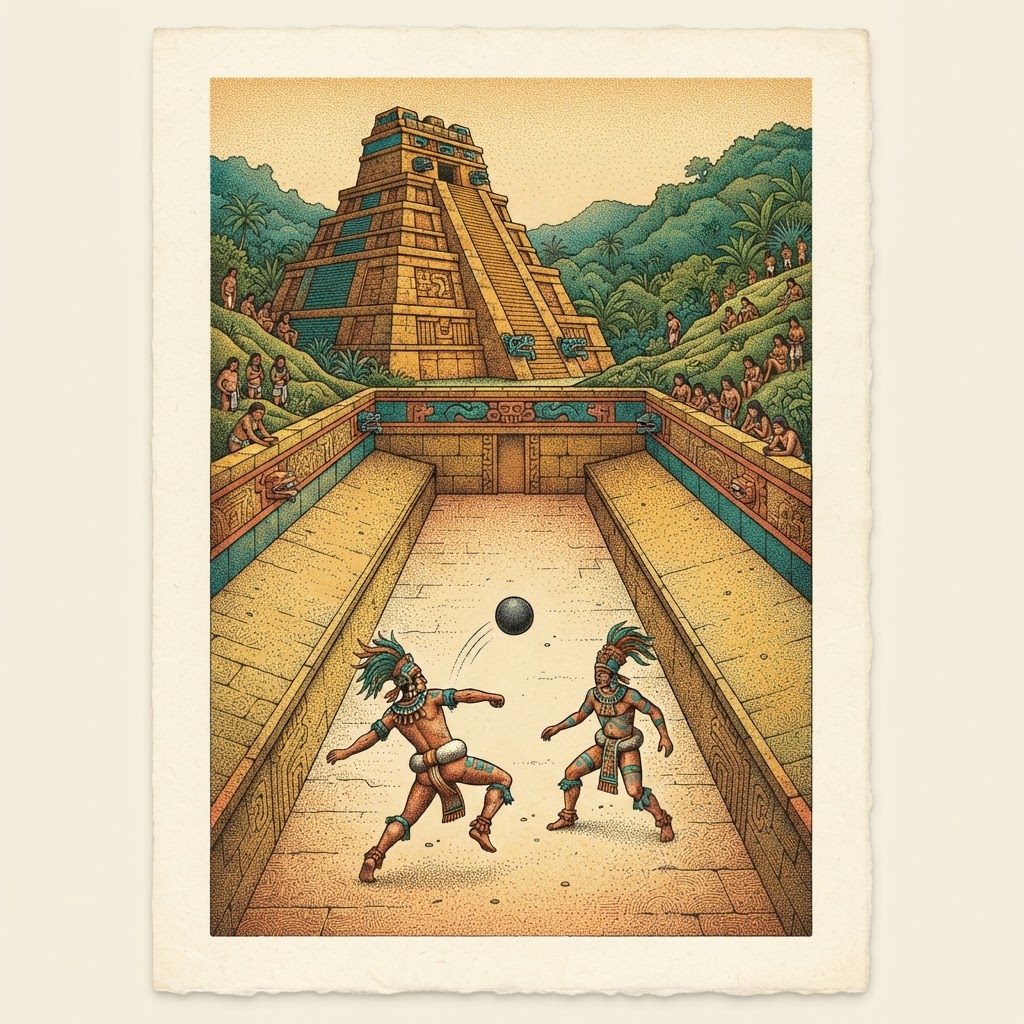
Half a world away, another sporting landscape was developing on its own terms. Mesoamerica's rubber ballgame — played by striking a ball with the hips on an enclosed court — is documented by more than 2,300 probable ballcourts across the region. [4] Archaeologists report an early lowland court in Chiapas dating to about 1650 BCE, and in 2020 published the earliest known highland ballcourt, at Etlatongo in Oaxaca, dated to 1374 BCE. [4] The game carried weight far beyond recreation: ancient sources and imagery tie it to ritual, politics, and origin narratives such as the Maya Popol Vuh. [4] This was a separate tradition with its own cultural context — not a footnote to Greece, and not something that descended from Greek sport. Two societies, unconnected, both concluded that organized play deserved permanent architecture.
Rome: organizing crowds, access, and political display
The Romans industrialized the gathering. The Flavian Amphitheatre — the Colosseum — opened in the first century CE as the largest amphitheatre in the ancient world, engineered for stage machinery, services for spectators, and the orderly movement of enormous crowds through numbered gates and tiered seating. [5] Its games were gladiatorial combat and animal hunts — spectacle and political display by emperors, which is different in purpose and structure from modern competitive sport. [5] But the urban lesson was permanent: a venue is a machine for organizing people, and controlling that machine means controlling access, status, and the streets around it. The amphitheatre reshaped Rome; Rome shaped what an amphitheatre had to be.
Commons, greens, and who could play where
After Rome's fall in the west, European play largely went back to open ground. In much of medieval England, game followed land law: villages held commons for grazing, fuel, and gathering, and much arable land was cultivated in scattered strips that opened to communal grazing after harvest. [6] Football, in various rowdy local forms, was played across open ground between landmarks — games the gentry periodically tried to ban. Some forms survive today; Ashbourne's Royal Shrovetide Football has been played across the Derbyshire town from at least the seventeenth century, its earliest records lost to a fire. [7] These games assumed shared ground, because shared ground was what common rights provided.
“Long before anyone sold a ticket, communities had to decide where the game was allowed to happen — and that decision was always about land.”
Then the ground began to close. Enclosure — hedging and fencing land so that common rights could no longer be exercised — proceeded in England from the medieval period onward, driven first by sheep pasture and later by agricultural 'improvement.' [6] A detailed history of the process records that between 1760 and 1870, about seven million acres, roughly one-sixth of England, passed from common to enclosed land through some 4,000 acts of Parliament. [8] Regional experience varied enormously — enclosure agreements existed in sixteenth-century Germany but advanced there only after 1850, and Tudor governments at times pushed back [6] — but the direction was unmistakable. As commons disappeared, so did the no-rent, no-fence spaces where village games had lived. Play moved to schoolyards, private grounds, and, eventually, to places you paid to enter.
Industrial cities and the enclosed game
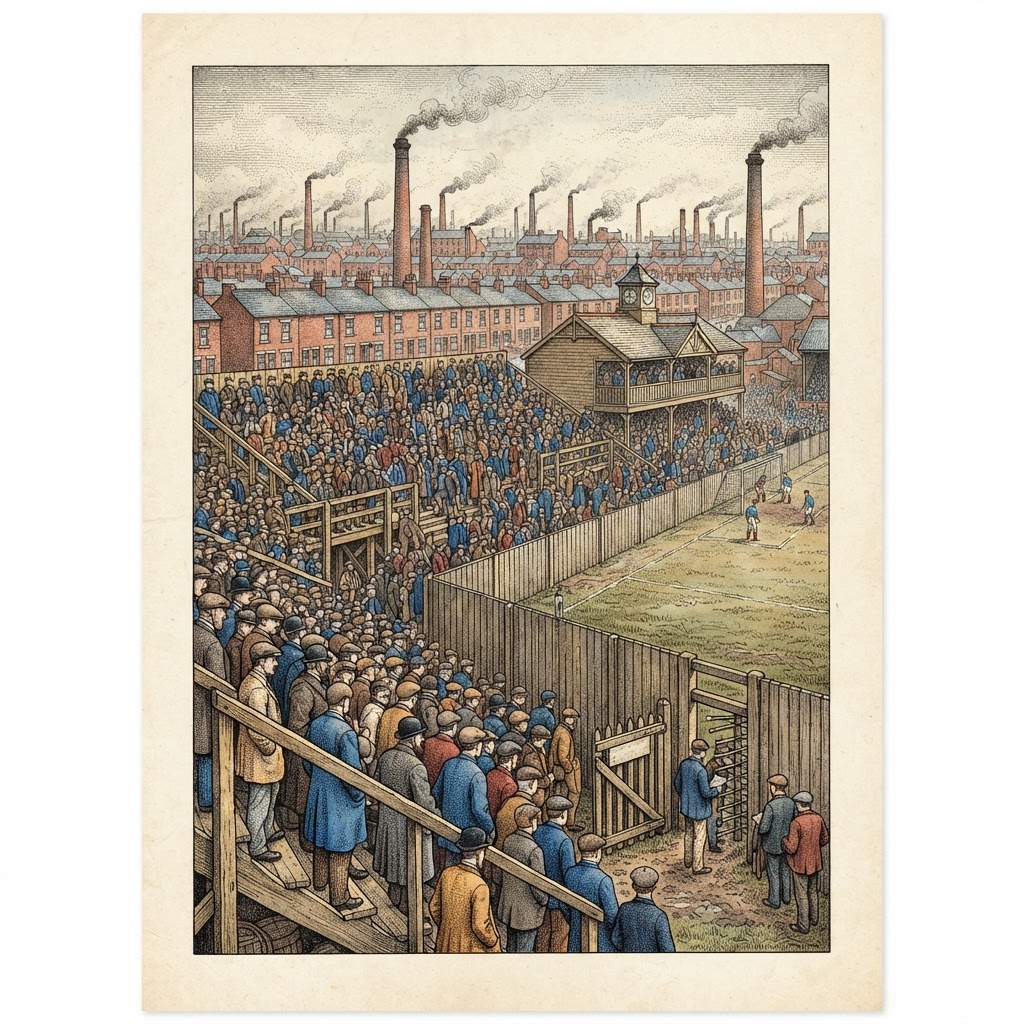
The industrial city finished the transformation. Work in mills and railways concentrated people in towns, roads and rail let fans travel, clubs codified rules and schedules, and entrepreneurs discovered that fencing a pitch and charging at the gate could pay for itself. The connection is real, though it should be stated as correlation rather than single-cause proof: enclosure pushed rural workers toward cities, cities supplied audiences, and audiences made enclosed, ticketed grounds profitable. None of those facts alone created the modern sports venue; together they did. The grandstand, the turnstile, and the season ticket are all land decisions — answers to who may enter and on what terms.
The neighborhood ballpark: Wrigley Field
American baseball built its own version at neighborhood scale. Wrigley Field opened in Chicago in 1914 and has hosted the Cubs since 1916; today it is the second-oldest ballpark in Major League Baseball and the oldest in the National League. [9] The National Park Service's account of its 2020 designation as a National Historic Landmark credits it with a string of firsts — the custom of letting fans keep foul balls, the first refreshment booths behind the stands, the first ballpark organ — and notes it hosted the first tryouts for the All-American Girls Professional Baseball League and the Chicago Bears from 1921 to 1970. [9] Its ivy and brick scoreboard arrived in 1937. [9]
What matters for our story is not the trivia but the relationship: a modest ballpark set directly into residential streets became part of the neighborhood's identity — the reason people without tickets still gather nearby on game days, and the reason preserving the building became a civic cause. A stadium can be more than a building; it can be the organizing landmark of a community. In 2020 the federal government agreed, formally adding Wrigley to a register of places the country chooses to remember. [9]
That was one side of the twentieth century's bargain: ballparks as neighbors. But as crowds, cities, and professional sport expanded, the land around the game became part of the business. Part Two follows what happened next.
A compact timeline
- c. 2350–2150 BCEAkkadian-era clay tablets in Mesopotamia record house and field sales in cuneiform (The Met). [1]
- c. 1650 BCEEarly Mesoamerican ballcourt documented in the Chiapas lowlands. [4]
- 10th century BCEOlympia develops as a sanctuary of Zeus; temples and athletic grounds share one valley. [3]
- 1374 BCEEarliest known highland Mesoamerican ballcourt, at Etlatongo, Oaxaca. [4]
- 776 BCE – 393 CETraditional span of the ancient Olympic festival at Olympia — a recorded tradition, not the invention of sport. [3]
- 1st century CEThe Flavian Amphitheatre (Colosseum) opens in Rome as the ancient world's largest amphitheatre. [5]
- 1760–1870Parliamentary enclosure converts roughly seven million acres of English common land. [8]
- 1914Wrigley Field opens in Chicago; the Cubs arrive in 1916; National Historic Landmark designation follows in 2020. [9]
Sources & Further Reading
- The Metropolitan Museum of Art — Cuneiform tablet: house sale contract, Quradum archive (ca. 2350–2150 BCE)
- The Metropolitan Museum of Art — Cuneiform tablet: field sale (ca. 20th–16th century BCE)
- UNESCO World Heritage Centre — Archaeological Site of Olympia
- Blomster & Salazar Chávez, “Origins of the Mesoamerican ballgame,” Science Advances (2020)
- Parco archeologico del Colosseo — The Colosseum (official site)
- Encyclopædia Britannica — Enclosure
- Wikipedia — Royal Shrovetide Football (Ashbourne, Derbyshire)
- The Land Magazine — A Short History of Enclosure in Britain (Simon Fairlie)
- National Park Service — Wrigley Field designated as a National Historic Landmark (2020)